
How to Save Your Diabetic Foot From Amputation?
Dr Krunal Gohil
The word amputation carries enormous weight. For a person with diabetes who has been told their foot wound is not healing, it can feel like an inevitable outcome. It is not. The majority of diabetes-related amputations are preceded by a non-healing foot ulcer and the majority of those ulcers are treatable if the right care reaches the patient at the right time. What follows is an honest, clear account of how that care works and what it takes to keep your foot.
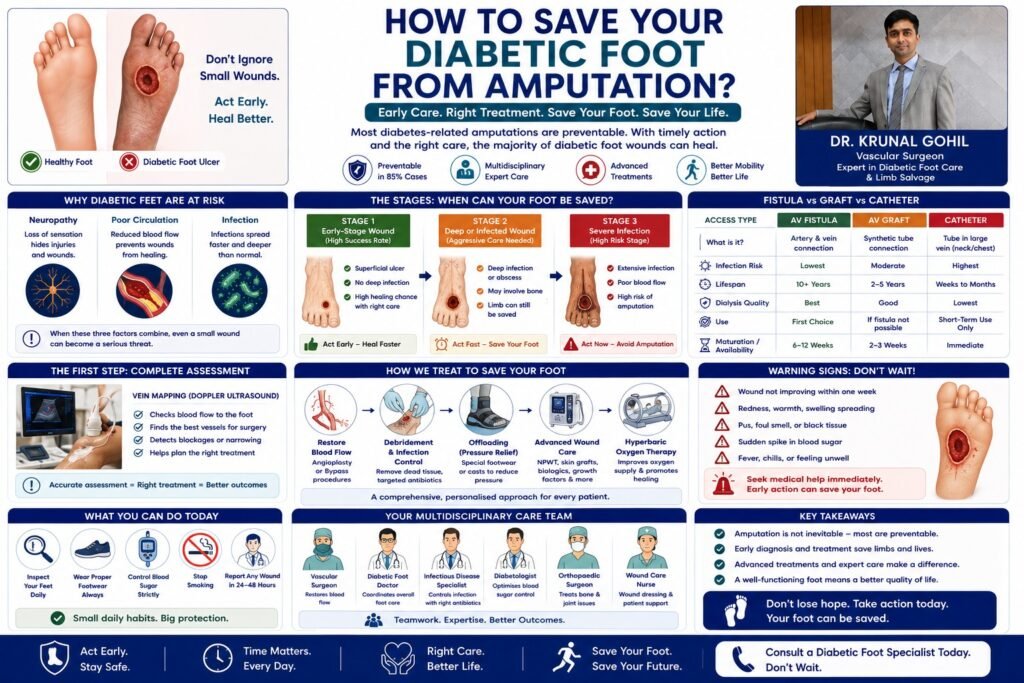
Why So Many Amputations Are Preventable?
Research consistently shows that 85% of diabetes-related lower-limb amputations are preceded by a foot ulcer. The same research shows that structured, multidisciplinary diabetic foot care programmes reduce amputation rates by 50% or more. These are not marginal improvements they represent thousands of patients who kept their limbs because they reached the right care team before the point of no return. The medical infrastructure to save diabetic feet exists. The critical variable is time.
The Emotional Weight of This and Why You Deserve Honest Information
Being told your foot may need to be amputated is one of the most frightening things a patient can hear. Fear often causes people to delay seeking care, avoid the conversation, or accept a single opinion without question. This blog is written for those patients. You deserve to know what is actually possible, what the care process involves, and at what stage options close. Clarity is not frightening uncertainty is.
Understanding Why Diabetic Feet Are So Vulnerable
Diabetic peripheral neuropathy is nerve damage caused by prolonged high blood sugar. It progressively removes sensation from the feet meaning cuts, blisters, pressure sores, and foreign objects inside shoes go completely unfelt. A wound can be present for days or weeks before it is noticed, and by that point infection may already be established in deeper tissue. This is the first layer of vulnerability: the absence of pain as a warning system.
Poor Circulation: Why Blood Cannot Reach the Wound
The second layer is vascular. Peripheral arterial disease (PAD) dramatically more common in diabetic patients narrows and hardens the arteries supplying the legs and feet. When blood flow is compromised, even a minor wound cannot receive the oxygen, immune cells, and nutrients it needs to heal. A wound without blood supply does not improve with dressings alone. Circulation must be assessed and, where necessary, restored before any wound care protocol can be effective.
Infection: The Factor That Accelerates Everything
In a foot that cannot feel pain and cannot receive adequate blood flow, infection spreads rapidly and without the usual warning signs. Bacteria reach bone in cases of osteomyelitis a deep infection that is difficult to treat and often the direct trigger for surgical decisions. The combination of neuropathy, ischaemia, and infection is what makes the diabetic foot genuinely dangerous. Addressing any one of these in isolation is not enough. All three must be managed simultaneously.
Early-Stage Wounds: High Success Rate With the Right Protocol
A Wagner Grade 1 or 2 wound a superficial ulcer or one extending into deeper tissue without bone involvement has a high rate of successful healing with proper management. At this stage, offloading removes the mechanical damage, debridement clears non-viable tissue, appropriate dressings maintain the wound environment, and blood sugar optimisation supports tissue repair. The success rate at this stage, with coordinated care, exceeds 80% in most published series.
Infected or Deep Wounds: Aggressive But Limb-Saving Care
A Wagner Grade 3 or 4 wound involves deep infection, abscess, or bone involvement. This is a serious stage but it is not automatically a surgical one. Aggressive wound care, targeted intravenous antibiotics, surgical debridement of infected tissue, and vascular intervention to restore blood flow can still salvage the limb in many patients at this stage. The window is narrower, the team required is larger, and the urgency is higher but limb preservation remains the goal and the outcome in a significant proportion of cases.
When Amputation Is Raised and When a Second Opinion Matters
There are situations where amputation is genuinely the safest and most appropriate clinical decision when infection has spread beyond salvageable tissue, when blood supply cannot be restored, or when the patient’s overall condition makes prolonged limb salvage attempts too risky. These decisions are valid. But they should always come from a specialist team with dedicated diabetic foot experience, and any patient who has been advised toward amputation by a general team without a full vascular assessment has the right and arguably the responsibility to seek a second specialist opinion.
What Limb-Saving Treatment Actually Involves?
If a scan confirms significant arterial disease affecting the foot, vascular restoration becomes the first priority before wound care, before antibiotics, before anything else. Balloon angioplasty opens narrowed arteries from within using a catheter. Surgical bypass grafts redirect blood around blocked segments. Once blood flow is restored, the biological conditions for healing are established. Wound care that was previously failing often begins working effectively immediately after successful revascularisation.
Debridement, Infection Control, and Offloading: The Core of Diabetic Foot Treatment
Structured diabetic foot treatment follows a clear protocol once vascular status is addressed. Debridement removes dead, infected, or non-viable tissue that prevents new tissue from forming. Targeted antibiotics chosen based on tissue culture results, not guesswork control infection at the right depth. Offloading through total contact casts, removable boots, or therapeutic footwear removes the mechanical pressure that re-injures the wound with every step. These three elements must work in parallel, not sequentially.
Advanced Wound Care Techniques Saving Limbs Today
✔ Negative Pressure Wound Therapy (NPWT) — vacuum-assisted dressing that removes excess fluid and promotes granulation tissue formation.
✔ Bioengineered skin substitutes — living cell matrices applied to the wound bed to accelerate healing in chronic, stalled wounds.
✔ Hyperbaric oxygen therapy — high-pressure oxygen delivered in a sealed chamber, increasing tissue oxygenation in ischaemic wounds.
✔ Growth factor treatments — topical applications that stimulate the biological processes of wound repair at cellular level.
✔ Bone stimulators — used in cases of osteomyelitis to support healing after infected bone is removed.
Why a Diabetic Foot Doctor Coordinates What No Single Specialist Can Manage Alone
Saving a diabetic foot requires expertise across vascular surgery, infectious disease, endocrinology, orthopaedics, and wound care simultaneously. A diabetic foot doctor whether a specialist podiatric physician, vascular consultant, or diabetologist with dedicated foot expertise acts as the clinical coordinator of this team. They ensure that the vascular assessment happens before debridement, that antibiotics are culture-directed, that blood sugar is controlled throughout treatment, and that no single specialist’s intervention undermines another’s. This coordination is not a luxury. It is what makes the difference between limb salvage and amputation in high-risk cases.
What a Diabetic Foot Surgeon Does When the Wound Is Too Deep for Conservative Care
When infection has reached bone, when an abscess requires drainage, or when devitalised tissue is preventing the wound bed from granulating, a diabetic foot surgeon steps in. Their role is not to remove the foot it is to do the minimum necessary surgical intervention that gives the foot the best chance of healing. This may mean removing a single infected toe while preserving the rest of the foot, debriding a deep abscess cavity, or performing a local resection of infected bone. The philosophy of the experienced diabetic foot surgeon is always limb preservation first, with amputation as the last resort rather than the default.
The Multidisciplinary Team: Who Is in the Room
▶ Vascular surgeon — assesses and restores blood supply to the foot.
▶ Diabetic foot doctor — coordinates care across all specialties and manages overall wound strategy.
▶ Infectious disease specialist — directs antibiotic therapy based on culture results and infection depth.
▶ Diabetologist or endocrinologist — optimises blood sugar control throughout treatment.
▶ Orthopaedic or podiatric surgeon — addresses bone and joint involvement when present.
▶ Wound care nurse — manages dressing changes, monitors wound progress, and supports the patient between clinic visits.
What You Can Do Right Now to Protect Your Foot
- Inspect both feet every evening look for any new redness, swelling, blisters, cuts, or changes in skin colour.
- Never walk barefoot, even indoors pressure and friction from floors cause wounds neuropathy hides.
- Control blood sugar as tightly as your care team advises every percentage point of HbA1c matters.
- Stop smoking immediately smoking reduces peripheral blood flow at a rate no medication can counteract.
- Report any foot wound to your doctor within 24 to 48 hours do not wait to see if it heals on its own.
The Moment You Should Stop Managing This Alone
🔴 Any wound that has not improved within one week of home care
🔴 Redness, warmth, or swelling spreading beyond the wound edges
🔴 Discharge, foul odour, or black tissue at or around the wound
🔴 A sudden spike in blood sugar without a dietary explanation
🔴 Fever or chills alongside a foot wound — this is a potential emergency
Your Foot Has a Fighting Chance If You Act Before It Is Too Late
Diabetic foot amputation is one of the most preventable surgical outcomes in modern medicine. The wound on your foot is not a verdict. It is a signal and signals can be responded to. The earlier that response happens, the more options remain on the table, the simpler the treatment, and the better the outcome.
Do not manage this alone, and do not accept a prognosis without a full specialist assessment. Seek out a diabetic foot doctor or diabetic foot surgeon who works within a multidisciplinary team. The difference between losing a foot and keeping it often comes down to who you see and how quickly you see them. dv