
How to Create an AV Fistula for Dialysis?
Dr Krunal Gohil
For anyone facing kidney failure and the need for dialysis, one of the first and most important decisions involves how blood will be accessed during treatment. An arteriovenous fistula commonly called an AV fistula is the gold standard answer to that question. Understanding what it is, how it is created, and what the process involves helps patients approach this step with confidence rather than anxiety.
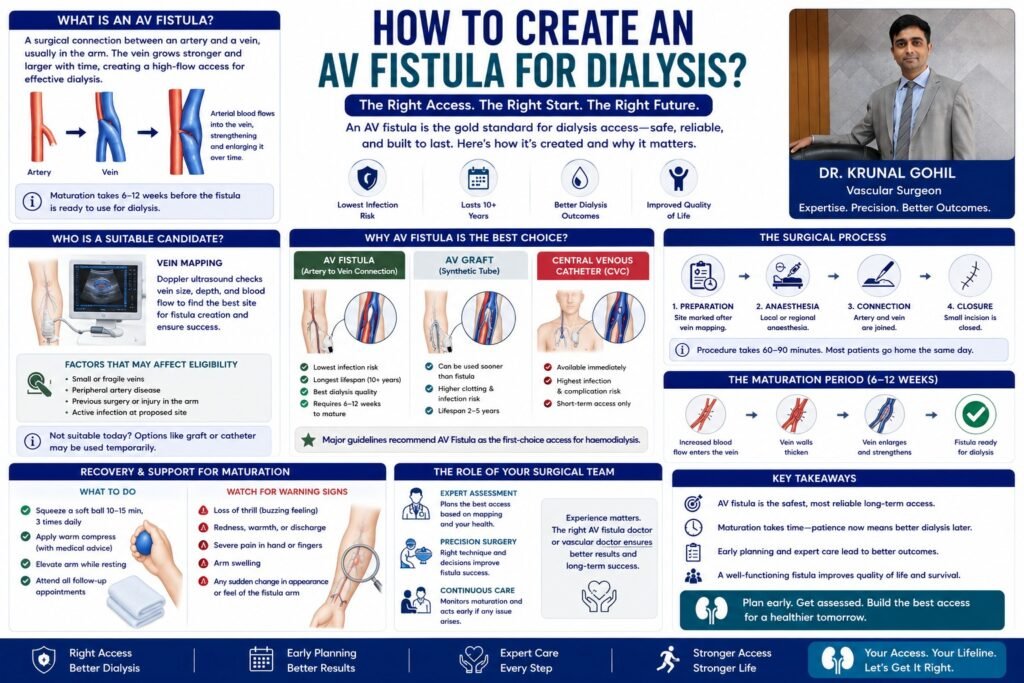
What Is an AV Fistula and Why Does It Matter for Dialysis?
An AV fistula is a surgical connection made between an artery and a vein, usually in the forearm or upper arm. Under normal anatomy, arteries carry high-pressure, oxygen-rich blood away from the heart, and veins return blood at much lower pressure. When these two vessels are surgically joined a procedure called an anastomosis arterial blood flows directly into the vein. The vein, now carrying blood at a much higher pressure and flow rate, gradually expands, thickens its walls, and becomes what is called a matured fistula: a large, robust vessel capable of being punctured with dialysis needles multiple times per week for years.
Why Dialysis Needs More Than a Regular Vein Can Offer
Haemodialysis requires blood to be withdrawn, cleaned through a dialysis machine, and returned to the body typically for three to five hours per session, three times a week. This process demands blood flow rates of 300 to 500 millilitres per minute. A standard vein simply cannot sustain that. It would collapse, clot, or become damaged within a short time. The AV fistula solves this by creating a permanently accessible, high-flow vessel that withstands the repeated demands of long-term dialysis.
Why an AV Fistula Is the Preferred Access Over Other Options
- AV Fistula — Surgical connection of artery to vein. Lowest infection risk, longest lifespan (10+ years), best dialysis quality. Requires maturation time of 6–12 weeks.
- AV Graft — Synthetic tube connecting artery to vein. Can be used sooner than fistula, but higher clotting and infection rates. Lifespan 2–5 years.
- Central Venous Catheter (CVC) — Inserted directly into a large neck or chest vein. Available immediately but carries highest infection and complication risk. Intended as short-term access only.
Lower Infection Risk, Longer Lifespan, Better Outcomes
Major clinical guidelines including those from the Kidney Disease Outcomes Quality Initiative (KDOQI) consistently recommend the AV fistula as the first-choice access for haemodialysis. Compared to grafts and catheters, fistulas have significantly lower rates of infection, thrombosis, and hospitalisation. Patients with a well-functioning fistula also receive more effective dialysis sessions, which directly translates to better long-term survival outcomes. The investment in creating and maturing a fistula early is one of the most clinically sound decisions a dialysis patient can make.
Who Is a Suitable Candidate for AV Fistula Surgery?
Vein Mapping: The Assessment That Decides Whether a Fistula Is Possible
Not every patient has veins suitable for fistula creation. Before surgery is planned, a vascular assessment called vein mapping is performed using Doppler ultrasound. This scan measures the diameter, depth, and flow of both the proposed artery and vein, identifies the best anatomical site for the anastomosis, and checks that neither vessel is too diseased or narrow to support a functional fistula. Vein mapping is not optional it is the foundation of surgical planning and significantly improves the chances of fistula maturation success.
Conditions That May Affect Eligibility
Patients with small or fragile veins, severe peripheral arterial disease, previous surgery or injury to the arm, or active infections at the proposed site may not be immediate candidates for fistula creation. In these cases, a graft or temporary catheter may be used while vascular health is optimised. Some patients require multiple mapping sessions or staged interventions before a fistula becomes viable. The key point is that eligibility is assessed individually a single failed mapping does not mean a fistula is permanently off the table.
The Surgical Process: What Actually Happens
The most common location for an AV fistula is the non-dominant forearm, where the radial artery is joined to the cephalic vein a configuration called a radiocephalic fistula. If forearm veins are insufficient, the upper arm is used instead typically connecting the brachial artery to the cephalic or basilic vein. Surgeons prefer the most distal (furthest from the heart) site possible, preserving more proximal sites for future use if the initial fistula fails or needs revision.
What to Expect on the Day: Anaesthesia, Duration, and the Procedure
AV fistula creation is typically performed under local or regional anaesthesia on a day-surgery basis. General anaesthesia is used in selected cases. The procedure takes between 60 and 90 minutes. The surgeon makes a small incision at the chosen site, isolates the artery and vein, and creates a side-to-end or end-to-side connection between them. The incision is then closed, a light dressing applied, and the patient is observed for a short recovery period before going home the same day in most cases.
The Surgical Process: What Actually Happens
The most common location for an AV fistula is the non-dominant forearm, where the radial artery is joined to the cephalic vein a configuration called a radiocephalic fistula. If forearm veins are insufficient, the upper arm is used instead typically connecting the brachial artery to the cephalic or basilic vein. Surgeons prefer the most distal (furthest from the heart) site possible, preserving more proximal sites for future use if the initial fistula fails or needs revision.
What to Expect on the Day: Anaesthesia, Duration, and the Procedure
AV fistula creation is typically performed under local or regional anaesthesia on a day-surgery basis. General anaesthesia is used in selected cases. The procedure takes between 60 and 90 minutes. The surgeon makes a small incision at the chosen site, isolates the artery and vein, and creates a side-to-end or end-to-side connection between them. The incision is then closed, a light dressing applied, and the patient is observed for a short recovery period before going home the same day in most cases.
The Maturation Period Why You Cannot Use It Immediately
Once created, the fistula needs time to mature before it can be used for dialysis. As arterial blood flows into the vein, the vein wall gradually thickens, the vessel dilates, and blood flow increases to the levels required for dialysis. This process called maturation typically takes six to twelve weeks. A fistula that is punctured before it has matured adequately is at significant risk of damage, clotting, or failure. Patience during this period is not just advisable it is clinically essential.
What the First Six Weeks Look Like
Mild swelling, bruising, and tenderness around the surgical site are normal in the first week and resolve gradually. The fistula should be palpable as a gentle buzzing or vibration called a thrill which confirms blood is flowing through it. Patients are advised to keep the arm elevated when resting, avoid tight clothing or jewellery on the arm, and not allow blood pressure measurements or needles on the fistula arm. Regular check-ins with the care team during this phase allow early detection of any maturation problems.
Exercises That Support Fistula Development
- Gentle squeezing of a soft ball or foam for 10 to 15 minutes, three times daily, increases blood flow through the arm and encourages vein development.
- Warm compresses applied over the fistula site (with medical approval) promote vasodilation and support maturation.
- Arm elevation during rest reduces post-operative swelling and supports healing in the early weeks.
Signs of a Problem When to Act Immediately
- Loss of thrill (buzzing sensation) — may indicate clotting. Contact your care team the same day.
- Increasing redness, warmth, or discharge at the wound site — possible infection.
- Severe or worsening pain in the hand or fingers — possible steal syndrome (blood diverted away from the hand).
- Significant swelling of the entire arm — possible venous hypertension or outflow problem.
- Any unexplained change in the appearance or feel of the fistula arm.
Why the Experience of Your AV Fistula Doctor Directly Affects Your Outcome
Fistula creation is technically demanding. The anastomosis must be performed with precision the angle, the vessel diameter match, and the suture technique all influence whether the fistula matures successfully or fails in the early weeks. An experienced AV fistula doctor brings not only surgical skill but the clinical judgement to select the right site, anticipate anatomical challenges, and make intraoperative decisions that improve long-term patency. Published data consistently shows that fistula success rates are significantly higher in centres and surgeons with dedicated vascular access experience.
What a Vascular Doctor Assesses Before, During, and After
A vascular doctor managing AV fistula creation takes a longitudinal view of the patient’s care. Before surgery, they review vein mapping results, assess cardiovascular fitness, and plan the optimal access strategy for the long term not just the immediate procedure. During surgery, they adapt to what the anatomy reveals in the operative field. After surgery, they monitor maturation progress, intervene early if the fistula is failing to develop, and coordinate with the nephrology team to ensure the access is ready before dialysis begins. This continuity of specialist care is what gives patients the best chance of a fistula that works well from the first session and lasts for years.
A Well-Created Fistula Is the Foundation of Effective Dialysis
An AV fistula is more than a surgical procedure it is the access point through which years of life-sustaining treatment will be delivered. Getting it right matters enormously: the right site, the right timing, the right surgical technique, and the right post-operative care all determine whether the fistula becomes a reliable, long-lasting resource or a repeated source of complications.
If you or a family member is approaching dialysis and the question of vascular access has come up, speaking with an experienced AV fistula doctor or vascular doctor early well before dialysis is urgently needed gives the fistula the best possible chance to mature and be ready when treatment begins.