
Why Do My Legs Hurt After Standing All Day?
Dr Krunal Gohil
You have been on your feet all day and by evening your legs ache, feel heavy, and just want to rest. If this happens regularly or is getting worse, your legs may be telling you something important about your vein health.
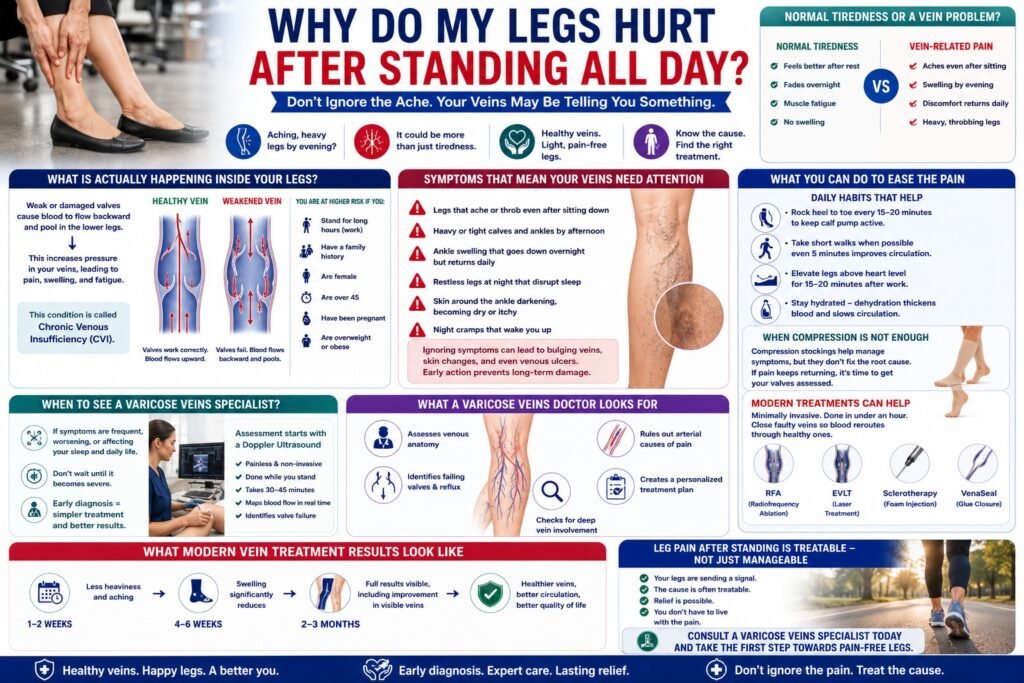
Normal Tiredness or a Vein Problem? Here Is How to Tell
Muscle fatigue feels better after a short rest and fades overnight. Vein-related pain is different your legs still ache when you sit down, feel swollen by evening, and the discomfort returns day after day. When you stand still, your calf muscle pump stops working and blood pools in the lower legs, building pressure in your veins. That pressure is what causes the throbbing, heavy feeling at the end of a long shift.
What Is Actually Happening Inside Your Legs?
Your leg veins have tiny one-way valves that push blood upward against gravity. When these valves weaken, blood flows backward and pools a condition called venous reflux. Over time this becomes chronic venous insufficiency (CVI), affecting an estimated 1 in 3 adults over 45. Many patients have no visible veins at all just aching, heaviness, and swelling that builds as the day goes on.
Risk is higher for people in standing occupations (nurses, teachers, chefs), those with a family history of vein conditions, women, older adults, and those who have been pregnant or have excess body weight.
Symptoms That Mean Your Veins Need Attention
If you notice any of these regularly, everyday fatigue is probably not the cause:
| ⚠️ Legs that ache or throb even after sitting down |
| ⚠️ Heavy or tight calves and ankles by afternoon |
| ⚠️ Ankle swelling that goes down overnight but returns daily |
| ⚠️ Restless legs at night that disrupt sleep |
| ⚠️ Skin around the ankle darkening, becoming dry or itchy |
| ⚠️ Night cramps that wake you up |
As the condition progresses, more visible signs appear bulging veins, sock-mark swelling, or skin that turns brownish and leathery. Left untreated, this can lead to venous ulcers. Early action prevents the condition from reaching that point.
What You Can Do to Ease the Pain?
Daily Habits That Help
- Rock heel to toe every 15 to 20 minutes to keep the calf pump active.
- Take short walks when possible even 5 minutes improves circulation.
- Elevate legs above heart level for 15 to 20 minutes after work.
- Stay hydrated dehydration thickens blood and slows circulation.
When Compression Is Not Enough?
Medical-grade compression stockings help by pushing blood upward but they manage symptoms, not the cause. If discomfort keeps returning despite compression and rest, it is a sign that damaged valves need to be assessed. Modern varicose veins treatment is minimally invasive, done in under an hour, and includes options like radiofrequency ablation (RFA), laser treatment (EVLT), sclerotherapy, and VenaSeal all of which close off the faulty vein so blood reroutes through healthy ones.
When to See a Varicose Veins Specialist?
Many people delay seeing a varicose veins specialist assuming it means surgery. It does not. Assessment starts with a Doppler ultrasound painless, non-invasive, done while you stand, and completed in 30 to 45 minutes. It maps blood flow in real time and shows exactly where valves have failed.
A varicose veins doctor goes beyond symptom management. They assess venous anatomy, identify failing valves, check for deeper vein involvement, and rule out arterial causes of leg pain. For patients who have been self-managing for years, one specialist visit often explains everything.
What Modern Vein Treatment Looks Like?
Vein stripping surgery is largely a thing of the past. Today’s procedures are performed in a clinic under local anaesthetic most patients walk out and return to light activity the same day, with no hospitalisation or surgical scars.
Most patients notice less heaviness and aching within one to two weeks. Swelling settles over four to six weeks, and full results including improvement in visible veins appear within two to three months. For most people the difference is significant: legs that felt like weights at the end of every day simply feel normal again.
Leg Pain After Standing Is Treatable Not Just Manageable
Aching legs after a long day are not an inevitable part of working hard. They are a signal and in most cases, a treatable one.
Do not wait for symptoms to worsen. Reach out to a varicose veins specialist and find out what is actually causing the pain and what can be done about it.