
How Modern Medicine Has Made Artery Treatment Safer Than Ever Before
Dr Krunal Gohil
Not long ago, a diagnosis of arterial blockage in an older patient often came with a difficult conversation. The blockage needed treatment, but the body may not withstand major surgery. Families were left weighing risks against outcomes, and doctors had limited options to offer.
That picture has changed significantly. Medical technology has advanced to a point where treating blocked arteries even in patients in their 70s and 80s is safer, faster, and far less physically demanding than it once was.
What Has Changed in the Way Doctors Treat Arterial Blockage Today?
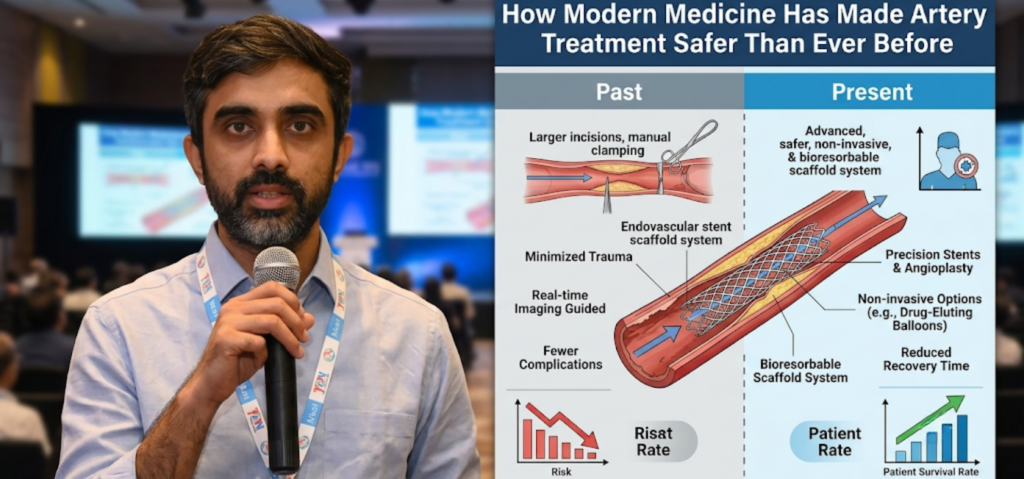
For decades, open surgery was the primary route to addressing serious arterial blockage. It worked, but it came with substantial recovery time, anaesthesia risks, and post-operative complications all of which weigh heavier on an older body. Today, the approach has fundamentally shifted. The goal is now to treat the artery with maximum precision and minimum disruption to the rest of the body.
Why Arterial Blockage Is More Common and More Complex in Older Adults?
Arterial blockage does not develop equally across age groups. In older adults, the process is often more advanced, more widespread, and complicated by other health conditions running alongside it.
How Decades of Plaque Build-Up Change the Artery Wall?
Over time, fatty deposits accumulate along the inner walls of arteries. In older patients, these deposits often harden with calcium, making the artery wall rigid and the blockage more resistant to standard treatment. The artery narrows progressively, reducing the oxygen supply to vital tissues the legs, the heart, the kidneys depending on which vessels are affected.
Why Traditional Surgery Was Not Always an Option for Elderly Patients?
Open bypass surgery requires general anaesthesia, large incisions, and weeks of recovery. For a patient managing diabetes, heart disease, or reduced kidney function alongside arterial blockage, the surgical risk itself can become as serious as the condition being treated. This left many older patients undertreated not because a solution did not exist, but because the tools available were too blunt for their situation.
How Modern Medical Tools Have Quietly Transformed Vascular Care?
The shift in vascular medicine over the last two decades has been significant. Advanced imaging now allows doctors to see inside arteries with extraordinary clarity measuring blockage length, assessing wall thickness, and planning treatment with a level of precision that was simply not possible before. Procedures that once required a full operating theatre can now be performed through a small entry point, often in under an hour.
Seeing Inside the Artery Imaging That Changed Everything
Technologies like intravascular ultrasound give vascular specialists a real-time, 360-degree view inside the artery during a procedure. This means treatment decisions are no longer based on estimates they are based on exact measurements. Stents are placed more accurately, outcomes are more predictable, and the chances of needing a repeat procedure are significantly reduced.
Treating Calcium-Hard Arteries Without Going Under the Knife
For arteries hardened by calcium deposits common in older patients newer tools use targeted sound waves to gently fracture the calcium within the artery wall before a stent is placed. This softens the blockage from the inside without damaging surrounding tissue, allowing the artery to be opened safely even when it was previously considered too rigid to treat effectively.
Why Minimally Invasive Procedures Are Now the First Choice for Most Patients?
The emergence of minimally invasive procedures has genuinely expanded who can receive treatment and how well they recover from it. Rather than large incisions and extended hospital stays, these approaches use small entry points often just a few millimetres through which specialised tools are guided directly to the site of the blockage.
Smaller Entry, Faster Recovery, Fewer Risks
Because the body experiences far less physical disruption, recovery is dramatically shorter. Most patients are mobile within a day or two. The risk of infection, bleeding, and post-operative complications drops considerably making treatment viable for patients who would previously have been considered too fragile for intervention.
How These Approaches Work Differently From Open Surgery?
In open surgery, the surgeon physically accesses and repairs the artery through a large incision. In contrast, minimally invasive approaches thread fine catheters through blood vessels from an entry point usually in the wrist or groin navigating to the blockage internally. No large wound, no significant blood loss, and no need for prolonged general anaesthesia in most cases.
What This Means Specifically for Patients in Their 60s, 70s, and Beyond
The advancement of vascular technology has had its most meaningful impact on older patients precisely the group that needed better options most.
Managing Multiple Health Conditions Without Adding Surgical Risk
An older patient dealing with diabetes, hypertension, and arterial blockage simultaneously no longer has to choose which condition to prioritise. Modern treatment approaches are designed to work around existing health complexities, not require a perfectly healthy body as a starting point.
Recovering at Home Instead of the ICU - A Real Difference
For an elderly patient, the difference between a two-day recovery at home and a two-week hospital stay is enormous physically, emotionally, and in terms of overall health trajectory. Shorter, gentler procedures support independence and reduce the risk of hospital-associated complications like infections or deconditioning.
The Best Time to Ask Your Doctor About Your Arteries Is Before Symptoms Take Over
Arterial blockage progresses quietly. By the time pain, discolouration, or reduced mobility becomes obvious, the blockage may already be advanced. The good news is that with today’s diagnostic tools, conditions can be detected and assessed far earlier and with today’s treatment options, action can be taken much sooner and more safely than before.
If you are over 55, have a history of diabetes, high blood pressure, or smoking, or simply have concerns about circulation a conversation with a vascular expert is always worth having. The technology available today means your age is not an obstacle. It is simply a starting point for the right plan.